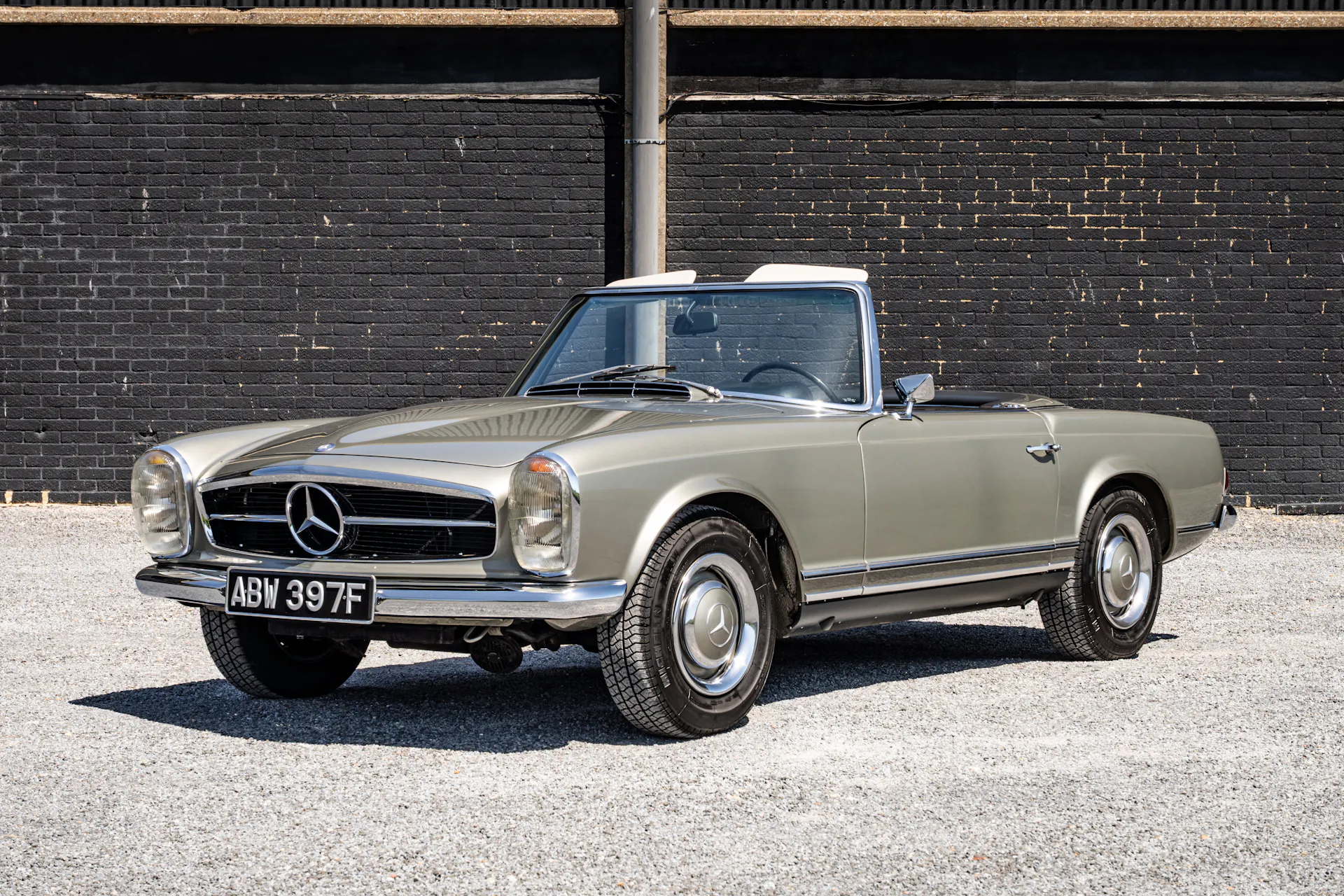
There are beautifully restored Mercedes-Benz Pagodas, and then there are the rare examples whose significance extends far beyond restoration alone. Cars that survive not merely as objects of design, but as artefacts of a particular world - preserved through generations of careful custodianship, accompanied by histories so richly documented that they feel less like motorcars and more like finely bound biographies.
This extraordinary 1967 Mercedes-Benz 250SL is one such car.
Produced during what many consider the golden era of Mercedes-Benz engineering, the 250SL remains the most intellectually coveted variant of the W113 Pagoda lineage. Built for barely a single year and limited to just 5,196 examples worldwide, it occupies the perfect middle ground between the early delicacy of the 230SL and the more mature refinement of the later 280SL. Lighter and more intimate than its successor, yet benefitting from the strengthened 2.5-litre M129 engine and rear disc brakes, the 250SL delivers an experience of remarkable balance and sophistication.
Finished in its exquisitely understated factory shade of DB178 Mittelgrau Metallic over black interior trim, this particular example possesses a depth of character seldom encountered today. In some light the paint appears a restrained charcoal grey; in others, soft sage-green undertones emerge beneath the surface with almost watercolour subtlety. It is an extraordinarily elegant colour - nuanced, architectural, and entirely period-correct - perfectly complemented by the richness and restraint of the black cabin.
Adding further distinction, the factory removable hardtop retains rare blue-tinted glass throughout all windows, not merely the windscreen - an exceptionally unusual and highly desirable period feature that lends the cabin a wonderfully atmospheric hue from within.
Yet as captivating as the aesthetics are, it is the provenance that truly elevates this Pagoda into rarefied territory.
Accompanying the car is an exceptionally complete and beautifully preserved history file, including its original sales invoice, rare stamped service book, period invoices, specialist restoration records, and numerous original ancillary items that together provide a remarkably intimate portrait of the car’s life across nearly six decades.
Most notably, the car’s early history traces back to the distinguished Pew family of Philadelphia - one of America’s great old-money dynasties and principal shareholders of Sunoco Oil. The car was originally owned by Walter Pew before passing to his daughter, with their custodianship extensively documented throughout the history file via service records, inspection stamps, and invoices retained during her tenure. Such provenance feels entirely befitting of the Pagoda itself: discreetly affluent, cultured, and understated in precisely the way only true generational wealth tends to be.
Remarkably, the car covered exceptionally low mileage between its final recorded service inspection under family ownership and its eventual acquisition by its most recent custodian, further reinforcing the extraordinary originality and preservation evident throughout the vehicle today.
The car also retains several wonderfully rare surviving details so often lost with time, including its original Becker radio and an exceptionally rare original spare wheel tag - precisely the sort of minutiae that seasoned Pagoda collectors search years to find.
The accompanying restoration records document in excess of £26,000 of recent specialist expenditure alone, undertaken not as a cosmetic exercise, but as a deeply considered programme of preservation and sympathetic restoration. The invoices collectively read less like maintenance records and more like a catalogue of devotion.
Substantial expenditure with renowned Mercedes-Benz specialists SLS Hamburg documents the sourcing of correct factory-style trim, rubber seals, brackets, brightwork fittings, sunvisors, trunk components, mounting hardware, and countless Pagoda-specific details rarely addressed during lesser restorations. Specialist invoices further detail the refurbishment and re-chroming of the front grille assembly and brightwork, while respected coachtrimmers undertook the careful restoration of interior panels in correct Mercedes-Benz specification MB-Tex.
The car has also benefitted from:
Importantly, the restoration has been carried out with restraint and scholarship rather than excess. Nothing feels over-restored or artificially modernised. Instead, the car retains the warmth, tactility, and quiet dignity so often lost during contemporary restorations.
Particularly noteworthy is the exceptional preservation of the body structure itself. The original wheel arches remain beautifully intact, while the boot floor and boot pan present in wonderfully original condition - areas scrutinised immediately by knowledgeable W113 collectors. The car also retains its original complete factory tool kit, another increasingly elusive and highly prized survival.
Inside, the cabin possesses the sort of restrained mid-century elegance Mercedes-Benz executed better than almost anyone. The black interior, expansive glasshouse, delicate chrome detailing, and rare blue-tinted hardtop glazing create an atmosphere that feels more akin to a private members’ club on the Côte d’Azur than a conventional sports car.
On the road, the 250SL remains utterly enchanting. The M129 straight-six delivers its power with velvety smoothness and refined torque, while the visibility, steering delicacy, and composure remind one why the Pagoda became synonymous with sophisticated European grand touring during the 1960s.
This is not simply a restored Pagoda.
It is a highly original, beautifully documented, and exceptionally well-preserved example with aristocratic provenance, restored with immense care and intellectual honesty. A car whose appeal lies not in flamboyance, but in nuance, rarity, authenticity, and the deeply cultured life it has clearly lived.