1957 Mercedes-Benz 300 SL Roadster
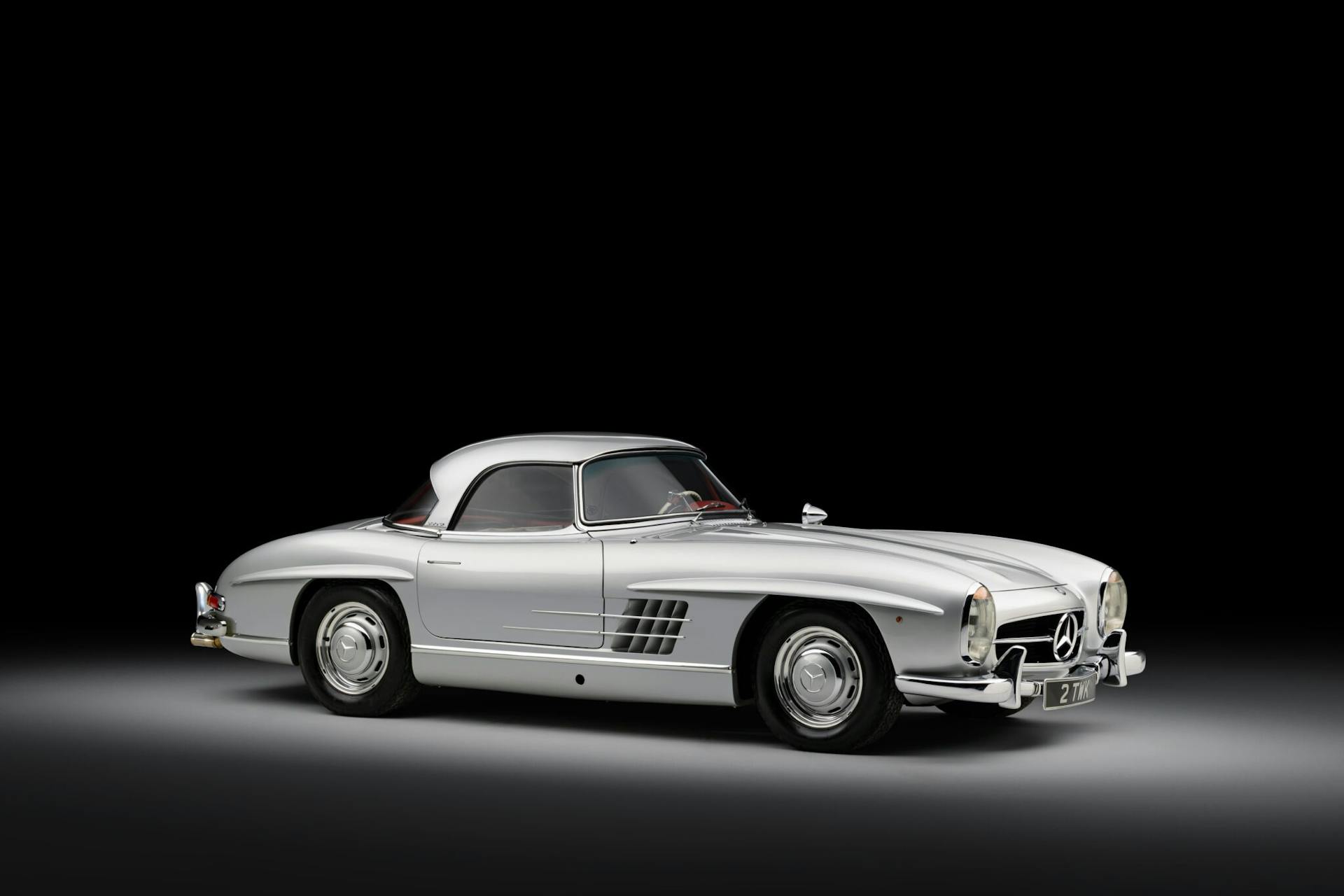
- Sold new in Venezuela and thoroughly restored in Italy in the 1990’s
- Acquired by the current owner in Italy in 2008
- Engine rebuilt by world renowned SL experts HK Engineering in Germany in 2012
- Complete interior retrim and hard top restoration carried out by highly regarded trimmers O’Keeffe in 2024
- Superbly maintained by 300 SL experts Martin Cushway Engineering
VEHICLE DESCRIPTION
The Mercedes-Benz 300SL is one of the most coveted sports cars of all time, and the Roadster model adds a touch of open-top style to its advanced engineering and undoubted pedigree.
The beautifully presented example being offered here comes with copies of its factory data sheets, which show that it was completed on 8 November 1957, finished in Ivory with a green interior and soft-top. The car was shipped from the port of Amsterdam to it’s first owner in Venezuela, a Mr Gustav Zingg. Zingg was the Mercedes-Benz importer and a retail magnate rumoured to be the wealthiest man in Venezuela at the time.
Among the options fitted was a Becker Brescia radio that had an adapter for ‘60m tropical band’. The tropical bands were a shortwave frequency typically used by broadcasters in areas such as South America, Africa, South-East Asia and Australia and the adapter fitted to this 300SL would have allowed its first owner to pick these up.
The car remained in Venezuela for many years before returning to Europe where the car was treated to a comprehensive, body-off restoration in the 1990s. The current owner acquired it from a Padova-based enthusiast and brought the car to the UK in early 2008.
After enjoying the car on a European rally, the current owner decided the engine would benefit from a rebuild and so sent it to renowned 300SL specialists HK Engineering in Germany in 2012. The Mercedes received a comprehensive overhaul to its 3-litre, six-cylinder engine, which is fully documented and invoiced.
O’Keeffe Coachtrimming Services carried out an interior retrim in 2024, and the factory hardtop was stripped, repainted and treated to new seals throughout. The bulkhead was also repainted in satin black. Regular maintenance has been carried out by the UK’s foremost Mercedes-Benz specialist Martin Cushway without regard to cost.
This Mercedes 300SL has been fastidiously maintained during its current ownership, and was displayed at the Goodwood Revival in 2018 as part of a tribute to legendary actor Steve McQueen, who owned a Roadster. Now being offered for sale in the stylish colour combination of silver with a red interior, it comes with an original parts book plus numerous invoices from recent years, and is a cherished example of this landmark sports car.
MODEL HISTORY
Mercedes-Benz had returned to motor racing in 1952 with the W194 300SL, which won that year’s Le Mans 24 Hours and the Carrera Panamericana road race in Mexico. Further developments and upgrades were planned for 1953, but the company’s attention insteadshifted to Grand Prix racing and the development of the W196 single-seater.
Over in America, however, influential distributor Max Hoffman could see the potential in a production version of the 300SL, and the project was given the go-ahead after Hoffman placed an order for 1,000 cars. The W198 Coupé – nicknamed the ‘Gullwing’ for its distinctive upward-opening doors – was duly unveiled at the New York Motor Show in February 1954.
The design strongly evoked the W194 racer and was based around a tubular chassis. The body was made from steel but had aluminium opening panels – there was also the option, at considerable extra cost, of an all-aluminium body – and beneath the bonnet lay a 240bhp, 3-litre, overhead-camshaft straight-six engine. Running on fuel injection and tilted over at an angle in order to reduce frontal area, it could power the 300SL to a top speed of 160mph, making it the fastest production car of its time.
‘The acceleration is truly remarkable,’ said The Autocar when it tested a 300SL. ‘The effect up to 60mph is not so noticeable as higher up when, with over 80mph showing, the rev counter needle swinging round rapidly towards the limit mark and third gear still engaged, the car fairly rockets forward.’
‘Gullwing’ production came to an end in 1956, but the following year a Roadster model was introduced at the Geneva Motor Show. It featured a modified chassis to allow for conventional doors, plus a redesigned low-pivot swing-axle rear suspension set-up that gave more predictable handling and a better ride quality. The engine produced an extra 10bhp, too, and there was the option of a factory hardtop.
Production of the Roadster lasted until early 1963 and fewer than 2000 were built, its all-round abilities having led Road & Track magazine to call it ‘a truly great dual-purpose sports car.’