1955 Alfa Romeo Giulietta Sprint
£ 195 000
banner image
  • The earliest known Giulietta Sprint to survive in original specification
  • Sold new to Swedish racing driver Jo Bonnier
  • Fastidious nine-year restoration carried out with painstaking attention to detail
  • Built in January 1955 as the 12th Giulietta Sprint


VEHICLE DESCRIPTION

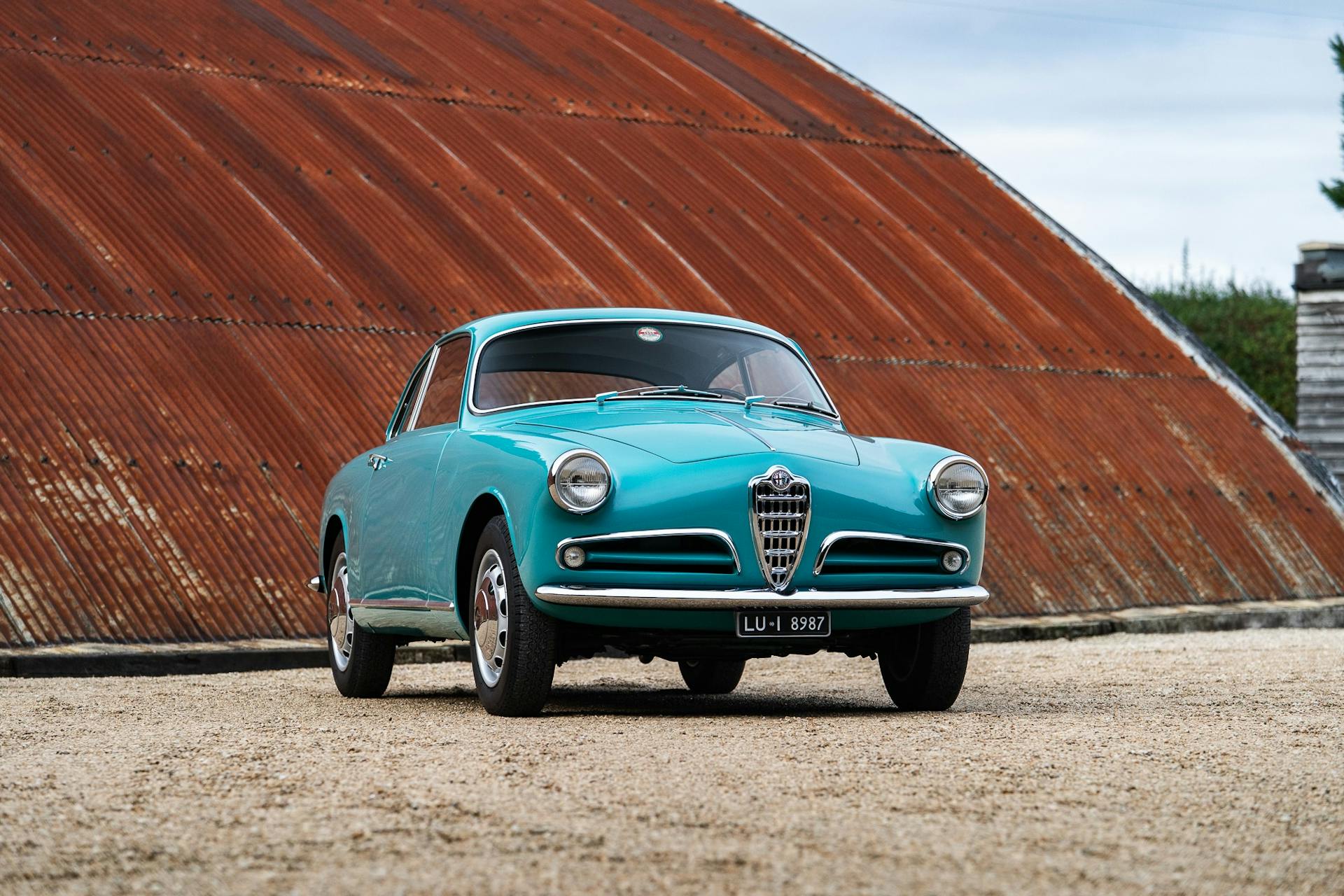
This is a very special example of Alfa Romeo’s coveted Giulietta Sprint. Superbly restored in recent years with fanatical attention to detail, it is the oldest known example to survive in its original specification.


Chassis number ‘00024’ was the first Giulietta Sprint to be completed in 1955, after production had started with 11 cars being completed in December 1954. This car is therefore the 12th to be built and includes distinctive features such as the lower roof line and more ‘squared off’ rear wheelarches, as well as no external badges. These were all specific to the earliest Giulietta Sprints, which were, in effect, ‘pre-production’ cars built to satisfy the overwhelming demand for the new coupé. 


The Alfa was sold new to Swedish racing driver Jo Bonnier, whose long career in Formula 1 and sports-car racing included victory in the 1959 Dutch Grand Prix. Bonnier had already raced and rallied Alfas, and the Giulietta Sprint was driven by his mechanic from Italy to Sweden on Milan licence plates. 


In the summer of 1955, Bonnier sold the car to Ivan Blom. Its current owner has spent a considerable amount of time piecing together its ownership history and established that the Alfa was bought by Frans Flisager in June 1959. It then went to Bo Dahlström of Stockholm in 1963, Per-Inge Brandström in 1969, and Kent Stig Olsson in April 1971. 


The Giulietta Sprint was then sold almost immediately to Bo Anders Ekvall. Later owners included Curt Anders Persson, who bought it in September 1991, and it was acquired by Axel Lind in August 2006. 


The current UK-based owner – an Alfa enthusiast since the early 1970s and past chairman of the Giulietta Register – bought it from Lind in 2007. The car had been in storage since 1970 and in 2009 he embarked on a nine-year restoration that was carried out with a painstaking dedication to originality and correctness. 


The work was overseen by leading Giulietta specialist Chris Robinson at RM Restorations.The original alloy engine block had likely suffered frost damage and been replaced sometime during the early life of the car with a slightly later pattern block, so a correct 1954 block was sourced in Italy and the engine built up using the original parts. The engine uses the original Solex twin-choke carburettor and ancillary parts.


Alfa specialist, John Holden of The Old Coachworks was tasked with restoring the bodywork, which was then finished in the original colour of Blu Chiarissimo. The original seat frames and covers were discovered beneath a later retrim, and Humphries Weaving brilliantly recreated the correct fabric. 


Inside and out, there was evidence of details that were unique to the earliest Giulietta Sprints, and the owner went to great lengths to ensure these were kept. One of the very few upgradeswas to fit an electric fuel pump to cope with modern fuels, but the body of the original mechanical pump remains in place on the front of the engine to retain the correct appearance.


A new front windscreen was specially made by Pilkington’s classic department, a tool-kit bag was made after sourcing the original-style canvas, and a set of tools was tracked down at considerable expense; the owner remarked that he’d bought cars for less. He even found a correctly dated Provisional handbook.


When the restoration was complete, the Giulietta Sprint was displayed in the Rotunda at the Royal Automobile Club’s Pall Mall clubhouse and featured in Classic & Sports Carmagazine and shown at the Hampton Court Concours. It remains in exceptional condition and drives superbly, having covered more than 2,000 kilometres since the restoration, and is now being offered for sale as a beautifully sorted and extremely significant piece of Alfa Romeo history. With FIVA papers, the car is highly eligible for many classic events, including the Mille Miglia.


MODEL HISTORY  

Few cars can match the timeless Italian chic of the Alfa Romeo Giulietta Sprint. The little coupé was launched in prototype form at the Turin Motor Show in April 1954 as the first of a Giulietta family that would eventually include Berlina, Spider and even a very rare estate – as well as the aerodynamic Sprint Speciale and competition-spec Sprint Zagato. 


At the heart of the Giulietta was Alfa Romeo’s all-alloy, twin-cam, 1290cc four-cylinder engine. Breathing through a single twin-choke carburettor, the early Giulietta Sprint produced 65bhp at 6000rpm which increased to 80bhp from 1958 and boasted a top speed of just over 100mph. The Sprint Veloce model was fitted with twin Weber carburettors and had a higher compression ratio, helping to boost power to 90bhp.


Designed by Franco Scaglione at Bertone, the Giulietta Sprint bodyshells were built at the firm’s Turin factory, and assembled at Alfa Romeo in the early days of production. It featured unitary construction, with independent front suspension and finned drum brakes all round.  


When Car & Driver magazine tested a Giulietta Sprint, it said that it ‘can carry two people from point A to point B over all types of roads quicker than most cars twice its size. It does this not with blinding speed but with a wonderful combination of roadholding, compact size and sheer willingness.’


Production of the various Giulietta models lasted until 1965, by which time Alfa Romeo had introduced the new Tipo 105 coupé.